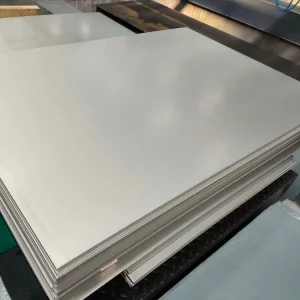
High-Precision Sanitary & Industrial Stainless Steel Solutions
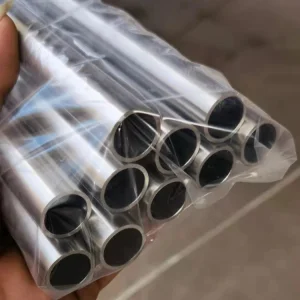
Explore mill-certified cold-rolled sheets, food-grade plates, and precision welded pipes manufactured to international ASTM, EN, and JIS specifications.

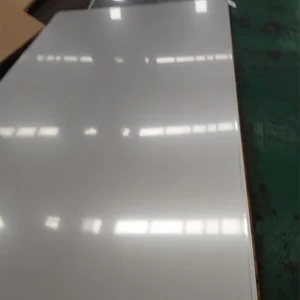




Demystifying Sanitary Stainless Steel Sheet Manufacturing
Understanding surface topography, passivation kinetics, and alloy composition requirements for high-purity processing environments.
Definition & Surface Roughness Metrics
Sanitary stainless steel sheets are specialized flat-rolled alloys designed to eliminate microscopic crevices, pits, and micro-voids where bacteria, biofilms, or chemical residues can harbor. Unlike standard commercial 2B finishes, sanitary grade materials strictly enforce micro-inch or micrometer roughness average ($Ra$) thresholds.
Typically, sanitary sheets mandate an $Ra \le 0.38\,\mu\text{m}$ ($15\,\mu\text{in}$) for high-purity pharmaceutical media, or $Ra \le 0.8\,\mu\text{m}$ ($32\,\mu\text{in}$) for standard food and dairy processing applications. Achieving this requires precise multi-stage mechanical polishing, bright annealing (BA), or electropolishing (EP).
Chemical Passivation & Chromium Film
The core mechanism behind sanitary performance is a continuous, self-healing chromium oxide ($\text{Cr}_2\text{O}_3$) passive layer. Advanced Chinese mills utilize automated citric acid (ASTM A967) or nitric acid passivation post-polishing to remove free iron particles embedded during cold processing.
By elevating the Chromium-to-Iron ($\text{Cr/Fe}$) ratio on the surface above 1.5, the material resists localized pitting corrosion, crevice attack, and rouge formation even under aggressive Clean-in-Place (CIP) and Sterelize-in-Place (SIP) thermal cycling.
Alloy Grade Metallurgy Comparison
Selection between SUS304, SUS316L, 2205 Duplex, and Super Duplex 2507 hinges on process chemistry, chloride ion concentration, and temperature thresholds:
- SUS304/304L: Standard food-grade alloy. Excellent formability, suitable for low-chloride media ($< 200\,\text{ppm}$) up to 60°C.
- SUS316L: Molybdenum-added ($2.0–3.0\%$) ultra-low carbon alloy. Resistant to chloride pitting ($< 1000\,\text{ppm}$), ideal for pharma & acidic foods.
- Duplex 2205 / 2507: High mechanical strength with Pitting Resistance Equivalent Number ($\text{PREN} \ge 35–42$), optimized for high-salinity marine or chemical sanitization.
China Manufacturing Capabilities & Scale
Data-driven insight into modern Chinese stainless steel rolling mills and quality assurance frameworks.
Sanitary Sheet Surface Finish & Technical Standard Matrix
Comprehensive engineering comparison across mill finishes, mechanical polishes, and chemical electro-treatments.
| Finish Designation | Processing Methodology | Roughness ($Ra$ Value) | Cleanability Rating | Primary Industrial Application |
|---|---|---|---|---|
| 2B (Cold Rolled, Annealed, Pickled) | Cold rolled, heat treated, pickled, light skin pass on polished rolls. | $0.40\,\mu\text{m} - 0.80\,\mu\text{m}$ | Standard | Storage tanks, utility piping, architectural cladding, base stock for polishing. |
| BA (Bright Annealed) | Cold rolled and furnace annealed in a controlled reducing atmosphere ($\text{H}_2/\text{N}_2$). | $0.15\,\mu\text{m} - 0.30\,\mu\text{m}$ | High | Dairy processing, commercial refrigeration, kitchen appliances, medical trim. |
| No.4 / Satin Finish | Unidirectional mechanical abrasive belt grit polish ($180 - 240$ mesh). | $0.30\,\mu\text{m} - 0.60\,\mu\text{m}$ | Moderate / Aesthetic | Food preparation tables, restaurant equipment, elevator interiors, cleanroom walls. |
| No.8 / Mirror Finish | Multi-stage fine abrasive buffing using ultra-fine polishing compounds. | $0.05\,\mu\text{m} - 0.15\,\mu\text{m}$ | Very High | Pharmaceutical mixing vessels, inspection windows, decorative high-end architecture. |
| EP (Electropolished) | Anodic electrochemical dissolution of surface high spots in viscous acid bath. | $Ra \le 0.12\,\mu\text{m} (5\,\mu\text{in})$ | Ultra-Sanitary (Maximum) | Bioreactor interiors, WFI (Water for Injection) systems, semiconductor gases. |
Integrated Industrial Cluster & Supply Chain Efficiency
How China's primary manufacturing hubs deliver unmatched cost-to-performance ratios and strict quality control.
Upstream Raw Material Integration
Leading Chinese suppliers operate directly in proximity to tier-1 stainless steel master mills, including Tsingshan, TISCO (Taiyuan Iron & Steel), POSCO, and Baosteel. This guarantees guaranteed chemical composition tolerances, minimal non-metallic inclusions, and full heat-lot traceability starting from raw pig nickel and ferrochrome melting.
Precision Cold-Rolling & Slitting Tech
Modern Chinese factories feature 20-high Sendzimir cold rolling mills, automated tension levellers, and continuous laser thickness gauging systems. These setups maintain sheet gauge tolerances within $\pm 0.01\,\text{mm}$, ensuring flat, stress-relieved sheets that eliminate oil-canning and distortion during downstream laser cutting and robotic welding.
Export Seaworthy Protection & Logistics
Sanitary sheets are highly susceptible to scratches and atmospheric contamination during transoceanic shipping. Chinese manufacturers utilize laser-cut double PVC/PE protective masking films ($70–100\,\mu\text{m}$ thickness), anti-humidity VCI (Vapor Corrosion Inhibitor) interleaving paper, and heavy-duty fumigated wooden crates reinforced with steel cradles.
Global Regulatory Compliance & Localized Support
Navigating international food-contact safety standards, pressure equipment directives, and environmental regulations.
To successfully integrate sanitary stainless steel sheets into global equipment fabrication lines, products must strictly adhere to regional certification standards. Leading Chinese exporters maintain robust quality management frameworks to ensure frictionless compliance verification for international buyers:
Food & Bio-Pharma Directives
Sheets manufactured for direct food, beverage, or pharmaceutical fluid contact comply with:
- FDA 21 CFR 175.300: Direct food contact material safety compliance.
- EHEDG Guidelines: European Hygienic Engineering & Design Group cleanability standards.
- 3-A Sanitary Standards: Strict surface design criteria for dairy and egg processing equipment.
- ASME BPE-2022: Bioprocessing Equipment standards governing surface finish categories (SF1 to SF6).
Material & Pressure Certification
Structural integrity and chemical verification are validated through internationally recognized testing standardizations:
- EN 10204 3.1 / 3.2: Independent or factory mill test certification providing full heat numbers.
- ASTM A240 / A480: Standard specifications for chromium and chromium-nickel stainless steel plate, sheet, and strip.
- PED 2014/68/EU: Pressure Equipment Directive compliance for high-pressure sanitary vessels.
- REACH & RoHS: Verification of zero hazardous substance contamination during pickling and passivation.
Localized End-Use Application Scenarios
From biopharmaceutical fermentation tanks to semiconductor ultra-pure water loops, sanitary stainless steel delivers engineered reliability.
Biopharmaceutical Fermentation
Material Spec: SUS316L Electropolished Sheet ($Ra \le 0.25\,\mu\text{m}$), ASME BPE SF4 finish.
Engineering Context: Used in vessel interiors, cell culture bioreactors, and WFI holding tanks. Electropolishing eliminates micro-asperities, preventing bacterial adhesion and enabling 100% effective SIP steam sterilization at 121°C.
Dairy Processing & Pasteurization
Material Spec: SUS304 / 304L Bright Annealed (BA) Sheet ($Ra \le 0.4\,\mu\text{m}$).
Engineering Context: Applied in plate heat exchangers, milk cold-storage tanks, and filling line hoppers. Smooth BA surface prevents milk-stone ($\text{Ca}_3(\text{PO}_4)_2$) buildup during continuous high-temperature short-time (HTST) pasteurization.
Semiconductor UPW Systems
Material Spec: High-Purity 316L / 904L / Duplex sheets with custom passivation.
Engineering Context: Ultra-Pure Water (UPW) storage and piping manifolds. Requires zero trace ion leaching (silica, iron, nickel) to prevent wafer contamination during sub-nanometer lithography rinsing processes.
Sanitary Metallurgy & Manufacturing Trends (2025-2030)
Key technological advancements driving next-generation stainless steel flat-rolled production.
1. Antibacterial Copper-Doped Alloys
Emerging sanitary sheets incorporate minor copper ($\text{Cu}$) additions ($1.5–3.0\%$) into the austenitic matrix. Spontaneous copper ion micro-release exhibits continuous antimicrobial efficacy ($\gt 99.9\%$ elimination of E. coli and S. aureus) without compromising base corrosion resistance or food safety compliance.
2. Green Steel & Low-Carbon Rolling
Leading Chinese mills are rapidly transitioning from Blast Furnace-Basic Oxygen Furnace (BF-BOF) routes to Electric Arc Furnaces (EAF) powered by green hydrogen and renewable solar energy. This cuts Scope 1 and Scope 2 embodied carbon footprints by up to 60%, aiding global OEMs in meeting Scope 3 ESG targets.
3. Automated AI Surface Defect Inspection
Inline high-speed optical camera arrays paired with AI computer vision now inspect 100% of rolling sheet surfaces at mill speeds exceeding 300 meters/minute. Defects like pinholes, micro-scratches, or roll-marks are flagged instantly, guaranteeing flawless surface delivery to international buyers.
Frequently Asked Questions & Procurement Guidance
In-depth technical answers addressing common engineering, compliance, and purchasing queries.
A 2B finish is a standard mill finish produced by cold rolling, heat treating, pickling, and passing through polished rolls, resulting in a smooth but non-reflective surface with $Ra$ typically between $0.4\,\mu\text{m}$ and $0.8\,\mu\text{m}$.
A Sanitary Bright Annealed (BA) or Electropolished (EP) finish undergoes special hydrogen furnace annealing or anodic electrochemical polishing, yielding an ultra-smooth, mirror-like surface ($Ra \le 0.15–0.38\,\mu\text{m}$). This ultra-low profile removes micro-pits, enabling efficient CIP/SIP cycles and preventing bacterial entrapment in food or pharma processes.
While SUS304 is ideal for basic food contact and low-chloride environments, SUS316L contains $2.0–3.0\%$ Molybdenum and lower carbon ($\le 0.03\%$). Molybdenum dramatically increases resistance to chloride pitting and crevice corrosion caused by sanitizing chemicals (e.g., sodium hypochlorite, peracetic acid) or acidic products (dairy, tomato sauce, citrus juices).
Furthermore, the low carbon content in 316L prevents chromium carbide precipitation during welding, preserving full corrosion resistance in heat-affected zones (HAZ).
Chinese factories utilize multi-head automated mechanical polishing lines equipped with digital pressure feedback sensors, fine-grit silicon carbide belts, and diamond compound paste. Final surface roughness is verified across multiple grid points per sheet using contact stylus profilometers or non-contact optical laser profilometers calibrated to ISO 4287 standards, with values documented directly on the Mill Test Certificate (MTC).
International buyers should specify a full quality dossier including:
- EN 10204 3.1 Mill Test Certificate: Detailing chemical heat analysis, mechanical yield/tensile tests, and elongation.
- Surface Roughness Inspection Report: Documenting $Ra$ measurements.
- Passivation & PMI Test Certificates: Confirming Positive Material Identification via XRF analyzer and acid-dip passivation quality.
- Compliance Declarations: FDA 21 CFR 175.300, EU 1935/2004, or ASME BPE declarations where applicable.
Sanitary sheets receive a protective PE/PVC laser film layer ($70-100\,\mu\text{m}$) to safeguard polished faces during fiber laser cutting. Sheets are interlayered with anti-humidity VCI paper, wrapped in waterproof plastic film, bound with heavy-duty steel strapping, and secured inside fumigated seaworthy wooden boxes or steel-skid pallets designed for container forklift handling.
Complete Mill-Certified Stainless Steel Range
Browse additional hot-rolled, cold-rolled, decorative, and structural stainless steel product lines direct from our Wuxi facilities.