
Precision Stainless Steel Pipe & Sheet Solutions
Certified mill-direct products engineered to ASTM A240, EN 10088-2, and JIS G4304 global industrial specifications.




1. Global Market Ecosystem & Industrial Dynamics of Stainless Perforated Sheet
Perforated stainless steel sheets represent a fundamental nexus of structural mechanics, acoustic damping, fluid dynamics, and industrial architectural aesthetics. As global infrastructure, chemical processing, automated manufacturing, and high-performance building envelopes evolve, the international demand for precision-punched metal plates has grown exponentially. Procurement teams, structural engineers, and industrial design buyers face an increasingly complex international marketplace where material purity, hole matrix tolerances, edge margin stress distribution, and landed pricing drastically impact project ROI.
China's stainless steel manufacturing ecosystem—centered in strategic metallurgical clusters such as Wuxi, Jiangsu, and Foshan, Guangdong—accounts for over 55% of the world's total cold-rolled and hot-rolled stainless steel processing capacity. Navigating the commercial landscape of China Stainless Perforated Sheet Suppliers & Pricelists requires a granular understanding of raw feedstock sourcing, automated CNC punch press capabilities, high-speed fiber laser micro-perforation, and localized supply chain resilience.
To select the appropriate perforated plate, engineering teams must weigh alloy composition against operational environments. Misspecifying an alloy in chloride-rich marine air or elevated-temperature chemical scrubbers leads to rapid pitting corrosion, stress corrosion cracking (SCC), and catastrophic structural fatigue around punched margins.
Metallurgical Grade Comparison Matrix for Perforated Sheets
| Alloy Grade | Chemical Composition Basis | PREN Value | Yield Strength (MPa) | Corrosion Resistance | Ideal Application Environments |
|---|---|---|---|---|---|
| AISI 201 (UNS S20100) | 16-18% Cr, 3.5-5.5% Ni, 5.5-7.5% Mn | ~17 | ≥ 310 | Basic Indoor | HVAC grilles, interior architectural cladding, acoustic furniture panels. |
| AISI 304 / 304L (UNS S30400/S30403) | 18-20% Cr, 8-10.5% Ni, <0.03% C (304L) | 18.0 - 20.0 | ≥ 205 | High General | Food processing screens, commercial kitchen extraction, architectural facades. |
| AISI 316 / 316L (UNS S31600/S31603) | 16-18% Cr, 10-14% Ni, 2-3% Mo | 23.0 - 25.0 | ≥ 220 | Superior Chloride | Offshore filtration, marine intake screens, pharmaceutical centrifuges. |
| Duplex 2205 (UNS S31803/S32205) | 22% Cr, 5% Ni, 3% Mo, 0.16% N | 32.0 - 35.0 | ≥ 450 | Extreme Industrial | Petrochemical catalyst beds, desalination pre-filters, high-stress centrifuges. |
| Ferritic 430 (UNS S43000) | 16-18% Cr, 0% Ni (Magnetic) | ~16 | ≥ 260 | Mild Atmospheric | Appliance front panels, dryer drums, automotive exhaust heat shields. |
Precision Perforation Manufacturing & Geometrical Calculations
From master coil slitting to tension leveling and CNC turret punching: how advanced Chinese mills ensure physical flat tolerances.
Raw Feedstock Leveling & Slitting
Cold-rolled prime coils from TISCO or Tsingshan are uncoiled and passed through 19-roller precision hydraulic flatteners to eliminate coil set and oil-canning stresses prior to punching.
High-Speed Multi-Ram CNC Punching
Utilizing sectional or wide-width sectional punch dies running at 600 to 1,200 strokes per minute. Specialized tungsten carbide tooling guarantees burr heights under 10% of sheet thickness.
Secondary Fiber Laser Micro-Punching
For ultra-fine aperture filtration requirements (holes < 0.8mm diameter), 12kW fiber laser systems execute sub-millimeter perforations without mechanical tool wear or edge deformation.
Mathematical Engineering: Calculating Open Area Percentage (% OA)
The Open Area (% OA) dictates airflow, light transmission, acoustic transparency, and hydraulic head loss. Sourcing engineers must verify open area using standard geometric formulas:
- 60° Staggered Round Holes (Most Common & Structurally Rigid):
% OA = (D² × 90.69) / C²(where D = Hole Diameter, C = Center-to-Center Pitch) - Square Pattern (Straight Rows):
% OA = (D² × 78.54) / (C₁ × C₂) - Slotted Holes (Staggered):
% OA = (W × L - 0.215W²) / (C₁ × C₂) × 100(where W = Slot Width, L = Slot Length)
3. China Stainless Perforated Sheet Pricelist & Cost Drivers
Establishing a realistic budget for importing stainless perforated sheets from China requires understanding that pricing is composed of two distinct components: **Base Metal Alloy Cost (linked to LME Nickel & Chromium index)** + **Perforation Processing Surcharge (tooling wear, stroke density, machine time, margin cutting, and post-leveling)**.
Standard Wholesale Benchmark Pricelist (FOB Port China - Shanghai/Ningbo/Qingdao)
*Note: Prices below reflect standard 1220x2440mm (4x8 ft) and 1500x3000mm sheet formats in 2B or No.4 finish. Prices fluctuate based on raw nickel markets.
| Material Grade | Thickness (mm) | Hole Pattern / Size | Open Area (%) | Price per Sheet (USD) | Price per Metric Ton (USD) |
|---|---|---|---|---|---|
| AISI 304 | 0.8 mm | Ø 2.0mm, 3.5mm Pitch (60° Staggered) | 29.6% | $28.50 - $34.00 | $2,350 - $2,650 |
| AISI 304 | 1.5 mm | Ø 3.0mm, 5.0mm Pitch (60° Staggered) | 32.6% | $48.00 - $56.00 | $2,280 - $2,550 |
| AISI 304 | 3.0 mm | Ø 6.0mm, 9.0mm Pitch (60° Staggered) | 40.3% | $92.00 - $108.00 | $2,200 - $2,480 |
| AISI 316L | 1.0 mm | Ø 2.0mm, 4.0mm Pitch (60° Staggered) | 22.6% | $49.00 - $58.00 | $3,600 - $3,950 |
| AISI 316L | 2.0 mm | Ø 5.0mm, 8.0mm Pitch (60° Staggered) | 35.4% | $88.00 - $104.00 | $3,500 - $3,850 |
| AISI 201 | 1.0 mm | Ø 3.0mm, 5.0mm Pitch (60° Staggered) | 32.6% | $19.50 - $24.00 | $1,550 - $1,800 |
| Duplex 2205 | 2.0 mm | Ø 4.0mm, 7.0mm Pitch (60° Staggered) | 29.6% | $145.00 - $170.00 | $5,200 - $5,800 |
Key Cost Multipliers in Custom Perforation:
- Hole-to-Thickness Ratio (Rule of 1:1): If the hole diameter is smaller than the sheet thickness (e.g., Ø 1.0mm hole in a 2.0mm 316L sheet), punch pin breakage rates increase by 400%. This requires slower laser perforation or specialized heavy-duty dies, adding a 25% to 50% price premium.
- Blank Margins vs. Full Perforation: Standard perforated sheets feature a unpunched border (e.g., 10mm or 20mm blank margins on 4 edges) to prevent panel warping and facilitate welding. Custom non-uniform borders require CNC programming adjustments and secondary shearing, adding $2.00–$5.00 per panel.
- Post-Punching Surface Finishes: Punching creates micro-oil contamination and thermal localized stresses. Secondary processing such as **Ultrasonic Degreasing**, **PVD Color Coating (Gold/Black/Rose Gold)**, or **8K Mirror Polishing** after perforation adds between $12.00 and $35.00 per square meter.
Cross-Sector Industrial & Architectural Deployments
How leading global original equipment manufacturers (OEMs) and civil engineering contractors integrate Chinese perforated sheets.
Architectural Building Envelopes & Sunscreens
Utilizing 304 and 316 grade sheets with 40% to 50% open areas, architectural perforated panels function as exterior rain-screens and solar shading louvers. They reduce building HVAC thermal loads by up to 32% while providing modern metallic aesthetic transparency.
Food & Sanitary Dewatering Vibratory Screens
In grain processing, sugar refining, and dairy spray drying, 304L and 316L sheets with smooth electropolished surfaces eliminate bacterial traps. Micro-perforated slots enable rapid liquid separation without clogging or structural distortion under vibratory loads.
Chemical Reactor Catalyst Bed Supports
Heavy-gauge 316L and Duplex 2205 perforated plates (5mm to 8mm thick) serve as high-load internal trays in petrochemical absorption columns. Capable of supporting heavy ceramic catalyst beds while maintaining uniform gas diffusion under high temperature and pressure.
Acoustic Damping & Power Gen Silencers
Perforated stainless sheets combined with basalt rockwool liners create non-combustible sound absorption barriers for gas turbine enclosures, diesel generator mufflers, and high-speed rail acoustic walls, achieving noise reduction coefficients (NRC) above 0.85.
EV Battery Pack Thermal Enclosures
Automotive tier-1 suppliers utilize precision-stamped 304 perforated heat shields within electric vehicle battery battery trays. These panels facilitate controlled thermal dissipation and flame propagation delay while minimizing overall chassis deadweight.
Marine Intake Screens & Desalination
Super Duplex 2507 perforated panels deployed in offshore seawater intake channels withstand velocity impact, marine bio-fouling, and severe pitting attack in high-salinity ambient ocean waters.
5. Wuxi & Industrial Hub Synergies: China's Efficiency Advantage
The primary advantage of sourcing perforated stainless steel sheets from top-tier Chinese manufacturers lies in **Vertical Supply Chain Integration**. In industrial metal manufacturing hubs like Wuxi (Jiangsu Province), the entire production lifecycle—from raw stainless slab melting and cold-rolling to precision coil slitting, high-speed CNC perforation, laser edge trimmed leveling, chemical passivation, and export seaworthy packaging—is concentrated within a 25-kilometer radius.
1. Direct Primary Mill Feedstock Procurement
Tier-1 factories maintain direct strategic supply contracts with major stainless steel primary producers including **TISCO (Taiyuan Iron & Steel)**, **Tsingshan Holding Group**, **POSCO ZPSS**, and **Baosteel**. This guarantees 100% heat-traceable chemistry, low residual tramp elements, and zero re-melt scrap contamination.
2. Rapid Tooling & In-House Die Tool Shops
Unlike Western service centers that outsource tool and die fabrication (leading to 4-6 week lead times for custom hole geometries), major Chinese producers operate in-house CNC wire-EDM die centers. Custom punch dies for non-standard staggered patterns or slotted matrices can be fabricated and tested within 48 to 72 hours.
Furthermore, logistics infrastructure surrounding Shanghai and Ningbo deep-water ports allows bulk container loading of heavy stainless sheet crates under strict sea-freight protection protocols. Wooden crates are ISPM-15 heat-treated, lined with vapor corrosion inhibitor (VCI) anti-rust film, and secured with heavy-duty steel banding to prevent humidity damage or transit shifting during 30-to-45-day ocean voyages.
Quality Inspection Protocols & International Compliance
Rigorous multi-stage quality control ensures that every shipment meets stringent European, American, and Asian industrial standards.
100% Positive Material Identification via handheld XRF analyzers on all incoming raw coils and outgoing finished panels to verify Cr, Ni, Mo percentages.
Full Material Test Certificates accompanying shipments, detailing mechanical yield, tensile strength, elongation, and chemical ladle analysis.
Laser flatness verification ensuring panel diagonal deviation is < 1.5mm per meter, and optical burr height gauge checking under ISO 2768-m.
Post-punch citric or nitric acid chemical pickling to restore the passive chromium-oxide surface layer destroyed by die heat and mechanical shear.
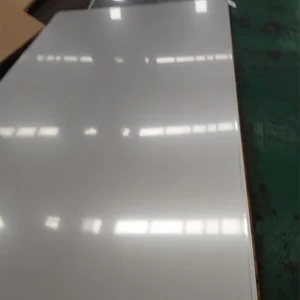
Stainless Steel Sheets, Plates & Industrial Tubing
Explore our complete range of certified industrial alloys, cold-rolled sheets, and custom-perforated structural solutions.


Frequently Asked Procurement & Engineering Questions
Direct technical answers from our senior metallurgical engineers and export logistics team.
Ready to Source Precision Stainless Perforated Sheets?
Submit your technical CAD drawings, required hole dimensions, alloy grade, and delivery port to our engineering sales team for a formal benchmark quotation within 24 hours.