
10 Best Stainless Steel Coil Suppliers for Global Buyers
Global buyers rarely choose a stainless steel supplier on price alone. They compare grade, finish, thickness tolerance, documentation, and delivery reliability. A coil that looks bright under warehouse lights can still fail a forming line if its surface or dimensions vary.
World Stainless reported global stainless-steel crude production of 58.4 million tonnes in 2023 in its Stainless Steel in Figures 2024 publication. This figure indicates the scale of the industry, but it is not a direct measure of coil demand. That distinction matters. Buyers should verify each supplier’s product range, mill certificates, inspection procedures, and ability to provide consistent batches. Ask about grades such as 304 and 316, but confirm the specification fits the application rather than relying on a grade name alone.
Small details count. A slit edge, protective film, or packing method can affect handling after arrival. So can a delayed certificate. The ten suppliers featured in this guide are intended as starting points for comparison, not automatic endorsements. Review their export experience, production capabilities, service options, and quality records against your own requirements. Request current documents and sample specifications before placing a large order. No list can replace due diligence. Supplier information changes, and published claims may not tell the whole story. That is worth remembering.
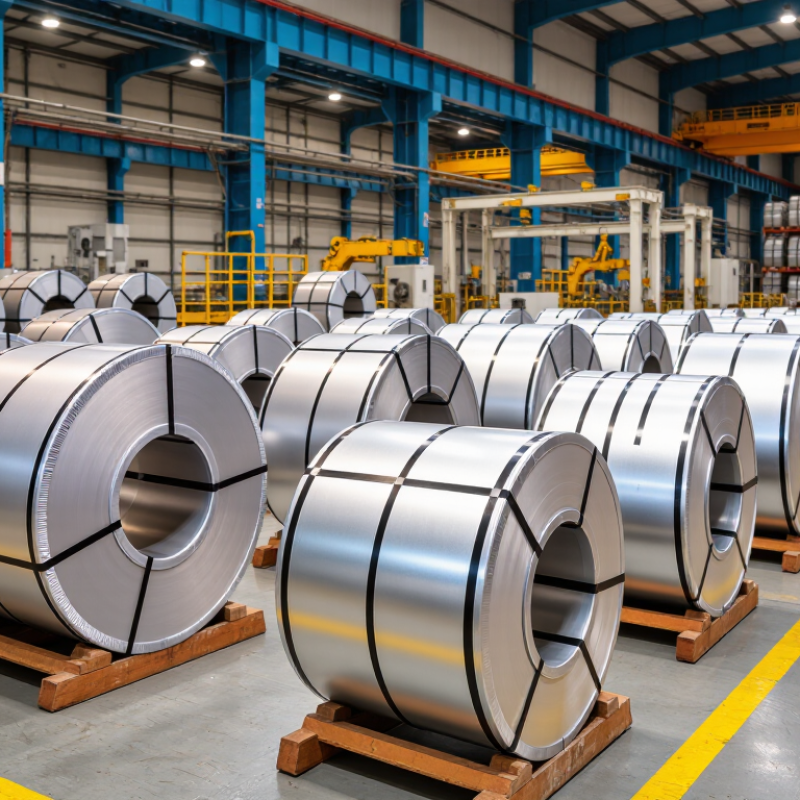
How Stainless Steel Coil Suppliers Serve Global Buyers
How Stainless Steel Coil Suppliers Serve Global Buyers
Global buyers need more than a low coil price. They need consistent grades, usable tolerances, and delivery dates they can plan around. The World Stainless Association reported 58.4 million tonnes of stainless steel melt-shop production in 2023, highlighting a large, internationally connected supply base. That scale does not guarantee every coil suits a buyer’s forming line. Experienced suppliers clarify grade, thickness, width, finish, edge condition, and required standards before quoting. They can also arrange slitting, protective film, export packing, and shipment documents. Ask for a mill test certificate linked to the coil’s heat number, then check that the details match the physical label. Small mismatch. Big delay.
Tip: Share a written specification and destination port before requesting quotes. Confirm the quotation’s Incoterm, packing method, and lead-time assumptions. For humid or long-distance routes, ask how the coil is wrapped and protected from moisture. Compare landed cost, not just the per-tonne figure. Sample inspection can help, though it cannot replace agreed quality checks for a full shipment. Suppliers sometimes need clarification too; vague requirements can produce a technically correct coil that still causes trouble on the production floor.
10 Best Stainless Steel Coil Suppliers for Global Buyers - How Stainless Steel Coil Suppliers Serve Global Buyers
| Supplier Profile | Typical Supply Base | Common Grades | Services Buyers May Request | Export and Documentation Considerations | Often a Good Fit For |
|---|---|---|---|---|---|
| 1. Integrated mill exporter | Large-scale stainless steel production operations serving domestic and export markets | Common austenitic grades such as 304 and 316; ferritic grades such as 430 may also be available | Mill-direct coil supply, production planning, standard surface finishes, and order-specific packing | Confirm the applicable product specification, inspection documents, shipment terms, and country-of-origin requirements | Large-volume buyers with planned demand and flexibility on production lead times |
| 2. Regional service-center supplier | Local or regional stockholding and processing facilities | Frequently stocked grades may include 304, 316, and 430, subject to local inventory | Slitting, cut-to-length processing, smaller order quantities, and prompt dispatch from stock | Check stock availability, processing tolerances, packing method, and delivery coverage before ordering | Buyers needing shorter lead times, smaller lots, or processed material |
| 3. Slitting-focused processor | Specialist processing facilities sourcing coil from mills or stockholders | Grade availability depends on incoming coil; 304 and 316 are common commercial requirements | Slitting to specified widths, edge-condition options, coil rewinding, and protective packaging | Agree on width tolerance, coil weight, inner diameter, edge quality, and inspection criteria in writing | Manufacturers that use narrow strip or require repeatable slit-coil dimensions |
| 4. Cut-to-length and sheet processor | Service centers equipped to convert coil into flat sheets or blanks | Common coil grades such as 304, 316, and 430, depending on the processor’s supply network | Leveling, cut-to-length sheets, blanking, and protective interleaving where offered | Specify sheet dimensions, flatness expectations, surface protection, and acceptable dimensional tolerances | Fabricators that need sheet formats rather than full coils |
| 5. Surface-finish specialist | Processors that supply or finish stainless steel coil and strip | Grade and finish combinations depend on available base material and processing capability | Supply of specified mill or processed finishes; confirm finish terminology and sample approval | Identify the required finish standard, surface protection, handling method, and inspection procedure | Appliance, architectural, and decorative applications with defined appearance requirements |
| 6. Project and contract supplier | Supply channels organized around scheduled orders and project requirements | Grades and quantities are defined by the project specification and confirmed sourcing plan | Order scheduling, consolidated shipments, production tracking, and document coordination | Confirm delivery milestones, document submission dates, inspection points, and change-control procedures | Infrastructure, engineering, and manufacturing projects with phased material demand |
| 7. Distributor with broad grade coverage | Multi-source distribution networks covering several product grades and formats | May cover austenitic, ferritic, and other stainless families; availability varies by market | Grade sourcing, mixed-order coordination, inventory checks, and support with technical inquiries | Verify the exact grade designation and equivalent standard rather than relying on a generic grade description | Buyers sourcing several grades or product formats through one purchasing channel |
| 8. Import-oriented stockholder | Domestic warehouse inventory sourced from international producers | Common commercial grades and dimensions selected for the local market | Local stock sales, order consolidation, and domestic delivery arrangements | Check the actual country of origin, import duties, available certificates, and local delivery terms | Buyers who value local availability and want to reduce the complexity of direct importing |
| 9. Application-focused supplier | Supplier or processor specializing in a particular end-use sector | Grades selected to meet the buyer’s specified service environment and product requirements | Material selection support, traceability coordination, and application-specific processing where available | Require confirmation that grade, condition, finish, and documentation meet the end-use specification | Buyers with defined requirements for food equipment, chemical processing, transport, or similar uses |
| 10. Multi-region sourcing partner | Trading or distribution network coordinating supply from more than one production region | Grade and dimensional range depend on approved sources and the buyer’s specification | Source comparison, order coordination, shipment consolidation, and communication across time zones | Establish source approval, inspection responsibility, traceability, payment terms, and dispute procedures | Global buyers seeking supply options across multiple regions or delivery locations |
These are generic supplier profiles, not named companies or a ranked list. Grade availability, dimensions, finishes, processing tolerances, lead times, and certificates vary by supplier and order. Buyers should confirm requirements against the applicable specification, such as ASTM A240/A240M or EN 10088, and the supplier’s current documentation.
FAQS
Share the grade, thickness, width, finish, edge condition, required standards, and destination port. Clear details reduce avoidable confusion.
Match the heat number on the mill test certificate to the physical coil label. One mismatch can delay receiving and production.
Compare landed cost, including freight, packing, and delivery terms. A low quote may not reflect the final expense.
Inspect a sample for thickness variation, surface finish, and edge condition. A sample helps, but it cannot prove every coil will match.
Ask how the coil is wrapped and protected from moisture. This matters on humid routes and during extended transport.
Integrated mills manage melting and rolling, while cold-rolling specialists may offer tighter thickness tolerances. Slitting services provide narrow widths and clean edges.
Request timing for the exact grade and width. General estimates can be misleading.
No. Check coil numbers against shipment records and consider a trial order. I would still verify claims; paperwork can look perfect.
Conclusion
This guide explains how Stainless Steel Coil suppliers support global buyers through product sourcing, customization, quality assurance, logistics, and ongoing service. It outlines practical criteria for evaluating potential partners, including material specifications, manufacturing capabilities, consistency, certifications, communication, lead times, and export experience. These factors help buyers assess whether a supplier can meet technical requirements and deliver reliably across different markets.
The article also profiles ten leading suppliers and compares their product ranges, quality practices, and international reach, without assuming that one option suits every business. It concludes with a straightforward selection approach: define your application and volume needs, compare verified specifications and service capabilities, request samples or documentation where appropriate, and consider total cost alongside reliability. By matching supplier strengths to business priorities, buyers can make informed decisions and build dependable sourcing relationships.
